The latest issue of our weekly Workplace Safety and Health newsletter is available for viewing and contains the following articles:

MSHA Rebuffed in Application of Flagrant Violation Tool. Federal Mine Safety and Health Review Commission Administrative Law Judge Alan Paez has rejected MSHA’s attempt to use prior citations and orders alleging “significant and substantial” violations (S&S) and unwarrantable failures to support a flagrant violation against Kentucky mine operator, Blue Diamond Coal Co.

OSHA Issues Guidance on Recordkeeping Duties for Temporary Workers. OSHA has issued a bulletin under its Temporary Worker Initiative to instruct staffing agencies and companies that hire temporary workers on their recordkeeping responsibilities. The agency’s Temporary Worker Initiative combines enforcement, outreach and training. It was launched because temporary workers were suffering serious or fatal injuries, many during their first days on the job. The bulletin is the first in a series of guidance documents intended to raise awareness about OSHA compliance requirements regarding temporary workers.

Ask a Jackson Lewis Attorney Q: We operate a 24/7 business. One of our employees has worked one weekend each month for the past two years due to her job requirements. Now, she has advised us that she can no longer work on Saturdays because she has become more religious, and Saturday is her Sabbath. Can she change her availability in this way? Do we have to excuse her from weekend work?

Click here to download the newsletter and read the full articles.

To sign up to receive the weekly newsletter, click here and fill out the form, then scroll down and check the box next to “Workplace Safety and Health Weekly Update,” which is the last item in the “Newsletters by Topic” section.  To receive all of Jackson Lewis’ workplace safety and health-related news, scroll down even farther and check the box next to “Workplace Safety and Health” under the “Areas of Interest” section.


The latest issue of our weekly Workplace Safety and Health newsletter is available for viewing and contains the following articles:

Enforcement, New Rules are Themes of MSHA, OSHA Budgets. Enforcement and new regulations are twin themes of the proposed 2015 fiscal year budgets of two Department of Labor (DOL) safety and health agencies.

More Money Proposed for ALJ Case Backlog. The number of workers’ compensation, immigration, wage and whistleblower cases has more than doubled over the past decade, while the number of judges available to handle them has declined.

Ask a Jackson Lewis Attorney. Q: We have a small business with 44 employees. Due to a sudden increase in customer orders, our president wants all employees in our production and fulfillment departments to work from 9-2 every other Saturday for the next three months. Several of our employees have claimed this violates wage and hour laws. What are the employees’ and the company’s rights in this situation?

Click here to download the newsletter and read the full articles.

To sign up to receive the weekly newsletter, click here and fill out the form, then scroll down and check the box next to “Workplace Safety and Health Weekly Update,” which is the last item in the “Newsletters by Topic” section.  To receive all of Jackson Lewis’ workplace safety and health-related news, scroll down even farther and check the box next to “Workplace Safety and Health” under the “Areas of Interest” section.

At a recent American Bar Association meeting, Jordan Barab, Deputy Assistant Secretary of Labor for OSHA, Dorothy Dougherty, Deputy Assistant Secretary of Labor for OSHA and Tom Galassi, Director of Enforcement Programs, all stressed the agency’s continued focus on key enforcement initiatives, such as temporary workers, workplace violence and heat stress.  In addition, they emphasized the increased use of corporate-wide settlement agreements and enterprise-wide relief and the continued use of the severe violator enhancement program (SVEP). According to OSHA, some of these initiatives are creative enforcement tools, and it was made clear that OSHA continues to see enforcement, as opposed to compliance assistance, as its primary objective.

This push on enforcement in the last several years is illustrated by recent statistics, such as the increase in the average penalty.  The numbers continue to reflect OSHA’s enforcement efforts. As indicated in the charts below, the average penalty per serious violation doubled in fiscal year 2011, with a slight drop in the average penalty for fiscal year 2013.  It appears that the average penalty per serious violation for fiscal year 2014 has increased, and is at the highest it has been compared to the previous four years.  Given that the fiscal year does not end until September 31, 2014, it remains to be seen if this average will increase or stay the same.

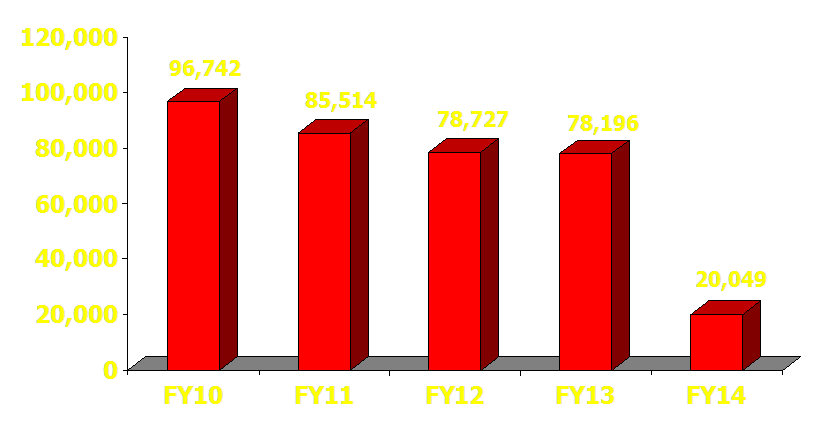
Interestingly, it seems that the sequestration had little impact on the total number of violations issued in 2013 compared to 2012. Both fiscal years averaged roughly 78,000 total violations issued.  However, this time last year, the number of total violations issued for fiscal year 2013 was roughly 26,000.  In comparison, to date for fiscal year 2014 the total number is roughly 20,000.  This drop in total violations is likely due to the government shutdown in October, which impacted the beginning of fiscal year 2014.

TOTAL VIOLATIONS ISSUED FY 2010-2014

Graph 1

AVERAGE CURRENT PENALTY PER SERIOUS VIOLATION

Graph 2

Also worthy of noting is that the percentage of inspections resulting from a complaint for fiscal year 2014 has already exceeded those for fiscal year 2013.  In short, complaint inspections are on the rise.  For the entire 2013 fiscal year 24% of inspections were the result of complaints.  For only a portion of the fiscal year 2014, that percentage is up to 28%.  This could average out the next few months; however, it appears that more inspections are resulting from employee complaints.

And while OSHA’s list of Top 10 Most Cited Standards typically changes very little year to year, for fiscal year 2014, the list included scaffolding and ladders.  Removed from the list was bloodborne pathogens and personal protective equipment.

FY 2014

Top 10 Most Cited OSHA Standards

  1. Fall Protection
  2. Hazard Communication
  3. Scaffolding
  4. Respiratory Protection
  5. Powered Industrial Trucks
  6. Electrical, Wiring Methods
  7. Lockout/Tagout
  8. Ladders
  9. Machine Guarding
  10. Electrical, General Requirements


The latest issue of our weekly Workplace Safety and Health newsletter is available for viewing and contains the following articles:

High Court Holds Time Changing Clothes Is Not Compensable.  A U.S. Supreme Court decision may well have put to rest the highly litigious issue of whether or not workers are entitled to payment for time spent putting on and taking off personal protective equipment (PPE).

Barges at Coal Load-out Facility Fall under MSHA, Judge Rules.  MSHA’s jurisdiction extends to the barge staging area of a terminal that employs workers who prepare and load the barges with shipments of coal. An administrative law judge made this ruling in a case arising after a 52-year-old deckhand fell off a barge into the Tennessee River in February 2012 and drowned.

Ask a Jackson Lewis Attorney.  Q: One of our employees just gave us notice that he is resigning, effective in two weeks. Can we tell him today is his last day?  If we do so, must we pay him for the two weeks?

Click here to download the newsletter and read the full articles.

 To sign up to receive the weekly newsletter, click here and fill out the form, then scroll down and check the box next to “Workplace Safety and Health Weekly Update,” which is the last item in the “Newsletters by Topic” section.  To receive all of Jackson Lewis’ workplace safety and health-related news, scroll down even farther and check the box next to “Workplace Safety and Health” under the “Areas of Interest” section.


President Obama recently issued the Department of Labor’s budget request for fiscal year (FY) 2015.  As part of the budget request to Congress, the Occupational Safety and Health Administration (OSHA) is seeking a total budget of $565 million, which is an increase of $12.7 million from the enacted FY 2014 budget.

OSHA is also requesting an additional $3 million for federal enforcement of the health and safety standards of the Occupational Safety and Health Act of 1970, as well as an additional $4 million and 27 FTEs to increase the resources needed to investigate and administer 22 whistleblower statutes under the Whistleblower Protection Programs. The budget also requests an additional $400,000 for the State Programs budget in order to fund the recently approved public employee State plan in Maine and an additional $3.5 million for the State Programs budget to ensure that the states have the resources to run programs that are as effective as OSHA’s Federal enforcement.

OSHA’s budget request for safety and health standards, technical support, and compliance assistant remain relatively flat with virtually no increase in funds.

In the FY 2015 budget, OSHA also includes two proposed amendments to its appropriation language: (1) a request to increase the amount that OSHA may retain from training institute course tuition and fees from $200,000 to $499,000 per fiscal year; and (2) a proposal to allow targeted inspections of small establishments that may have potential for catastrophic incidents (e.g., those subject to Process Safety Management or the EPA’s Risk Management Program).

Of particular note in the FY 2015 budget, OSHA asserts that the:

current appropriations language limits OSHA’s ability to conduct safety and health inspections of small businesses (10 or fewer employees) in industry codes that have lower-than-average workplace injury and illness rates.  Neither the number of workers in a company nor low injury and illness rates, however, is predictive of the potential for high-consequence catastrophic incidents, resulting in multiple casualties and extensive property damage that can damage whole communities.


In the last installment of this LOTO series, we address the periodic inspections and training requirements.   

Are We Performing Periodic Inspections?

Employers are required to conduct periodic inspections of their energy control procedures at least annually to ensure that they are being effectively implemented and to correct any deviations or inadequacies. 29 C.F.R. § 1910.147(c)(6). The periodic inspection must be performed by an “authorized employee” other than the one(s) utilizing the procedures being inspected.

The periodic inspection shall include a review between the inspector and each authorized employee of that employee’s responsibilities under the energy control procedures and of the limitations of the tagout systems, if used, as provided for in 29 C.F.R. § 1910.147(c)(7)(ii).

The employer is required to certify that that the periodic inspections were performed. The certification shall identify (1) the machine or equipment on which the energy control procedure was being utilized; (2) the date of the inspection; (3) the employees included in the inspection; and (4)the person performing the inspection.

Continue Reading Part 3: Will Your LOTO Program Stand Up to An OSHA Inspection?

Now that you have considered whether you are covered under the LOTO standard, it is time to consider whether you actually meet the basic requirements of the standards and have proper energy control procedures for each piece of equipment. 

Do We Meet the Basic Requirements under the LOTO Standard?

If employees are exposed to hazardous energy during servicing and maintenance activities and one of the exceptions above do not apply, then employers must establish, at a minimum, a program consisting of detailed energy control procedures for each piece of equipment, employee training, and periodic inspections.  29 C.F.R. § 1910.147(c)(1).

Do We Need and Have Detailed Energy Control Procedures?

Energy control procedures for each piece of equipment must be developed, documented, and utilized when employees are engaged in servicing and maintenance activities unless all of the following elements exist:

Continue Reading Part 2: Will Your LOTO Program Stand Up to an OSHA Inspection?

It seems that just about every week the Occupational Safety and Health Administration (“OSHA”) issues citations to another employer for its alleged failure to implement the requirements under the Control of Hazardous Energy standard, 29 C.F.R. § 1910.147 (better known as the Lockout/Tagout (“LOTO”) standard).  In fact, the LOTO standard has consistently been one of the top ten frequently cited standards issued by OSHA over the last several years.  Small or unsophisticated employers are not the only ones at risk for receiving citations for LOTO issues.  So, as spring approaches (eventually), it is a good time to do a little bit of “spring cleaning” with respect to your LOTO Program to ensure that if OSHA shows up at your worksite, you can feel confident that your program meets the necessary requirements and you have significantly reduced your risk for receiving a citation. 

Over the next few days, we will address some of the key questions you can be asking while evaluating your LOTO program.    Continue Reading Part 1: Will Your LOTO Program Stand Up to an OSHA Inspection?

On February 11, 2014, OSHA issued a long awaited Shipyard Employment “Tool Bag” Directive (CPL 02-00-156).  While the Directive provides compliance guidance to Compliance Safety & Health Officers (CSHO) for inspections of shipyard employers, it also provides guidance to covered employers.  The Directive is a source of information on how OSHA interprets various requirements and provides answers to commonly asked questions relating to the shipyard industry.

A significant portion of the Directive covers the relatively new requirements in Part 1915, Subpart F – General Working Conditions in Shipyard Employment.  On August 1, 2011, OSHA issued a final standard for General Working Conditions in Shipyard Employment, which set out requirements in the following areas:

  • Housekeeping, Lighting, and Working Alone
  • Medical Services/First Aid and Sanitation
  • Lockout/Tags-Plus (control of hazardous energy)
  • Motor Vehicles

Many of the revisions in the new rule are simply updates to existing requirements; however, the final rule is significant in that it is the first time that OSHA has established requirements for the control of hazardous energy (lockout/tagout) in the shipyard industry.  The new Directive provides guidance, including answers and questions regarding the application of lockout/tags plus in the shipyard industry.

A copy of the Directive can be found here:

https://www.osha.gov/pls/oshaweb/owadisp.show_document?p_table=DIRECTIVES&p_id=5799

The comment period ends on March 10, 2014, for OSHA’s request for information (“RFI”) on the potential revisions to its Process Safety Management (“PSM”) standard, Explosives and Blasting Agents standard, the Flammable Liquids standard, and Spray Finishing standard.  This RFI fulfills one of the Agency’s requirements under President Obama’s Executive Order 13650, entitled Improving Chemical Facility Safety and Security

OSHA identified the following topics as potential candidates for rulemaking or enforcement policy changes and included a list of questions specific to each:

1.  Clarifying the PSM exemption for atmospheric storage tanks.  OSHA seeks comments on whether it should clarify that the PSM standard covers all stored flammables when connected to, or in close proximity to, a process.

2.  Oil- and Gas-Well Drilling and Servicing Exemption.  OSHA requests public comment on whether it should retain or remove the current Oil and Gas Well Drilling and Servicing exemption from the PSM standard.

Continue Reading OSHA’s Comment Period Ends Soon for PSM RFI