The latest issue of our weekly Workplace Safety and Health newsletter is available for viewing and contains the following articles:

  • Federal Agencies Report Progress on Chemical Safety.  Agencies responsible for tightening chemical safety rules and procedures following a deadly explosion at a fertilizer plant last year say they are making headway.
  • OSHA Claims Trucking Firm Blacklisted Employee.  OSHA is seeking back wages and damages totaling more than $100,000 from a Missouri-based trucking firm after alleging the company unlawfully retaliated against a former employee when he sought medical attention for a work-related injury.
  • Upcoming Speaking Engagement.  In February, Mark Savit will present a seminar on “Alternative Case Resolution:  Understanding MSHA Litigation – Level the Playing Field” in Las Vegas. 
  • Employment Law Q&A.  Q: One of our employees has been on medical leave for about eight months following a stroke. He used all of his allotted FMLA leave but has not returned to work. Can we send him a letter stating that if he cannot return to work next week, his employment will be terminated?

Click here to download the newsletter and read the full articles.

To sign up to receive the weekly newsletter, click here and fill out the form, then scroll down and check the box next to “Workplace Safety and Health Weekly Update,” which is the last item in the “Newsletters by Topic” section.  To receive all of Jackson Lewis’ workplace safety and health-related news, scroll down even farther and check the box next to “Workplace Safety and Health” under the “Areas of Interest” section.
On January 15, 2014, the Occupational Safety and Health Administration (“OSHA”) launched an online resource tool to help hospitals assess workplace safety needs, implement safety and health management systems, and enhance their safe patient handling programs.  The online resource tool was created in an effort to assist hospitals in combating their high workplace injury and illness rates –  approximately 253,700 work-related injuries and illnesses were recorded in 2012. 

OSHA has identified a hospital as the most hazardous place to work in the United States, noting that the likelihood of an injury or illness resulting in days away from work is higher in a hospital than in the construction and manufacturing industries.  Data collected from the Bureau of Labor Statistics reveals that nearly half (48 percent) of injuries resulting in days away from work in hospitals are caused by overexertion or bodily motions, such as lifting, bending, or reaching.  These motions often relate to patient handling.  OSHA notes that high injury rates increase a hospital’s overall costs, much in the form of workers’ compensation payouts and loss productivity.  Continue Reading OSHA Launches Online Tool for Hospitals

Employers covered by the Occupational Safety and Health Administration’s recordkeeping rule must prepare and post OSHA Form 300A, “Summary of Work-Related Injuries and Illnesses,” by February 1, 2014, and keep the form posted until April 30, 2014.  The form must be posted at each establishment covered, in a conspicuous place where notices to employees are customarily posted.
 
After the form is completed, but before posting, a company executive must certify that “he or she has examined the OSHA 300 Log and that he or she reasonably believes, based on his or her knowledge of the process by which the information was recorded, that the annual summary is correct and complete.”
 
Under OSHA’s rule, a company executive can be one of the following:

  • An owner of the company (only if the company is a sole proprietorship or partnership);
  • An officer of the corporation;
  • The highest ranking company official working at the establishment; or
  • The immediate supervisor of the highest ranking company official working at the establishment.

OSHA can cite an employer who fails to post OSHA Form 300A as required.

California has enacted legislation that creates a new employer liability when employees miss “cooldown” periods.
 
Beginning Jan. 1, 2014, under Labor Code Section 226.7, California requires employers to provide one hour of pay to employees for missed recovery or “cooldown” periods to prevent heat illness. Employers in California should consider evaluating their business’ heat illness risks and prevention programs before the warmer months to ensure they decrease the likelihood of heat illness and are in compliance with California law.

You can access the full article here, which was co-written by Jackson Lewis Workplace Safety and Health attorney,  Benjamin J. Kim.  It appeared in today’s issue of Law360.

On December 27, 2013, OSHA quietly issued a memorandum to all Regional Administrators providing compliance guidance to Compliance Safety & Health Officers (CSHO) for inspections of manufacturers and importers under the revised Hazard Communication Standard.  Specifically, the guidance is meant to provide CSHOs with criteria for determining whether classifiers (manufacturers and importers) have appropriately classified “combustible dust.”

The revisions to the Hazard Communication Standard, 29 C.F.R. §1910. 1200, included a revised definition for “hazardous chemical.” The new definition defines a hazardous chemical as:

  any chemical which is classified as a physical hazard or a health hazard, a simple asphyxiant, combustible dust, pyrophoric gas, or hazard not otherwise classified.

Although there is currently no OSHA standard regulating combustible dust, OSHA has included combustible dust as a hazardous chemical. This means that all manufacturers and importers (classifiers) will now need to determine and appropriately classify their products as combustible dust. 

How exactly does OSHA anticipate that classifiers will do this?  In this recent memorandum, OSHA indicates that “[t]he classifier must consider not only the hazards of the chemical in the form it is shipped, but also consider the hazards that arise under normal conditions of use and foreseeable emergencies.” The memorandum instructs CSHOs when conducting inspections to determine if the classifier has used one or more of the following approaches to determine if such hazards exist:

  •  Laboratory Testing.  Classifiers can rely on screening tests, such as ASTM E1226 and E1515 to establish whether a material is a combustible dust.  If results of accepted tests indicate the material is combustible then according to OSHA is should be classified based on those results.  Additionally, OSHA seems to suggest that if a material would be considered combustible under OSHA’s combustible dust National Emphasis Program (NEP), which is any dust that has a Kst greater than zero, then it should be classified as combustible. 
  • Published Test Results.  The classifier may rely on published data, such as NFPA 61, 68 and 499 which lists test results for various materials.
  • Dust Particle Size.  In the absence of published test data, OSHA suggests that classifiers can rely on particle size, if such information is available. “If the material will burn and contains a sufficient concentration of particles 420 microns or smaller to create a fire or deflagration hazard, it should be classified as a combustible dust.”

 In addition, OSHA asserts that any product that has been involved in a deflagration or dust explosion event should be classified as a combustible dust.

Where a classifier does not use one of these approaches or elects not to classify a material as combustible despite the use of one or more of these approaches then the classifier will have to prove to OSHA why the data was discarded and the material was otherwise classified.  In short, the classifier will have an uphill battle to prove to a CSHO why the material is not combustible.

Manufacturers and importers have until June 15, 2015 to review current products and determine whether any products must now be classified as a combustible dust and if so, must classify these products as such on Safety Data Sheets (SDS).

OSHA’s memorandum can be found here.

The latest issue of our weekly Workplace Safety and Health newsletter is available for viewing and contains the following articles:

  • OSHA Citation Vacated for Lack of Scientific Support.  Relying on witnesses who ignore scientific evidence is not recommended by the U.S. Court of Appeals for the Seventh Circuit.
  • Criminal Charges Dropped against Mining Company, Foreman.  Ruling the government could not prove its case, a federal district court judge has thrown out criminal charges against a Virginia coal operator and its foreman.

Click here to download the newsletter and read the full articles.

To sign up to receive the weekly newsletter, click here and fill out the form, then scroll down and check the box next to “Workplace Safety and Health Weekly Update,” which is the last item in the “Newsletters by Topic” section.  To receive all of Jackson Lewis’ workplace safety and health-related news, scroll down even farther and check the box next to “Workplace Safety and Health” under the “Areas of Interest” section.

Wishing all  of our OSHA Law Blog subscribers a happy and healthy New Year!

On November 26, 2013 the full semiannual regulatory agenda for federal agencies was published.  This Regulatory Agenda provides a complete list of all regulatory actions that are under active consideration for promulgation, proposal, or review and covers regulatory actions for over 60 federal departments, agencies, and commissions.

In the current Unified Agenda the Department of Labor has listed a total of twenty eight regulatory entries for OSHA specific actions. This regulatory agenda differs from the published spring 2013 agenda.  Specifically, OSHA added three new agency actions to its agenda, including two for the construction industry and one for the shipyard industry.

For the shipyard industry, OSHA is considering possible changes to standards governing scaffolds, ladders and other working surfaces in shipyards. OSHA is considering splitting the current subpart into three subparts, Subpart E Stairways, Ladders and Other Access and Egress; Subpart M Fall Protection; and Subpart N Scaffolds. According to the agenda, OSHA will issue a request for information from the public about the possible rule changes in August 2014.

For the construction industry, OSHA has added two new proposed rules relating to the Cranes and Derricks in Construction Standard.  OSHA anticipates issuing a Notice of Proposed Rulemaking for Amendments to the Cranes and Derricks in Construction Standard in January 2014.  This Notice will address technical amendments and corrections to 1926.1400 (Subpart CC) – Cranes and Derricks in Construction.  Two of the proposed corrections included clarifying the exclusion of powered industrial trucks and defining the term “digger derrick.”

The second Notice of Proposed Rulemaking for the Cranes and Derricks in Construction Standard pertains to Operator Certification.  There has been considerable conflict between OSHA and interested stakeholders regarding OSHA’s interpretation that a crane operator must be certified on the specific type of crane and the specific capacity.  Many in the industry believe that capacity should not be a factor in operator certification.  In order to address this issue OSHA is delaying the operation certification/qualification requirements in the standard, which are effective November 10. 2014.  Under the Notice of Proposed Rulemaking OSHA would delay that effective date until November 2017.  OSHA anticipates issuing this Notice of Proposed Rulemaking in December 2013.

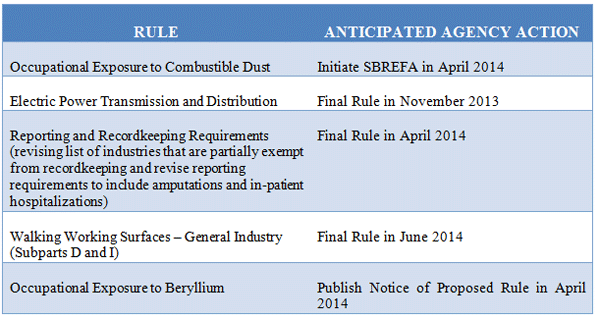
Additional regulatory actions under consideration by OSHA include:

 OSHA-Blog-Chart-12032013

The full federal Unified Agenda and Regulatory Plan can be found online at: http://www.reginfo.gov/public/do/eAgendaMain.

The New York Court of Appeals’ 4-3 decision allowing subjects of drug tests to sue laboratories for “negligent testing” may hold a lesson for employers who desire to test their employees, particularly when conducting on-site testing using specimens other than urine. It illustrates risks that attend employment-related drug testing, although the issue in the case was whether a laboratory that contracted with a county probation department to analyze drug tests performed on probationers may be liable to a test subject for a negligent drug test. Landon v. Kroll Laboratory Specialists Inc., 2013 NY Slip Op 6597 (Oct. 10, 2013).  Read the full article here.

The Occupational Safety and Health Administration’s (“OSHA”) Notice of Proposed Rulemaking to “Improve Tracking of Workplace Injuries and Illnesses” was published in the Federal Register on November 8, 2013.  The proposed rule amends the recordkeeping regulations to add three new requirements for the electronic submission of injury and illness information to OSHA.  In addition, OSHA will publicly post the electronically-submitted injury and illness information on its website and may create a searchable online database.  Employers and the public will have until February 6, 2014, to submit written comments on the proposed rule.   

The proposed rule does not expand coverage of the recordkeeping requirements or change the information that an employer is currently required to collect and maintain under 29 C.F.R. Part 1904.  Only those employers, who are already required to keep injury and illness records, will be subject to the new electronic-submission requirements discussed below.  Thus, employers with 10 or fewer employees or establishments in certain low-hazard industries, such as finance, insurance, retail, or real estate, are not subject to the new electronic requirements unless OSHA informs them in writing to keep such records and electronically submit them.    Continue Reading OSHA’s Proposed Electronic Recordkeeping Rule

By adopting the “Florida Ban on Texting While Driving Law,” Florida has joined 41 other states where texting while driving is illegal. The new law prohibits, as a secondary offense, manual texting, e-mailing and instant messaging on a wireless device while driving. Drivers cannot be pulled over for texting alone; rather, the driver must have engaged in a separate traffic offense. The new law adds Section 316.305 to the Florida Statutes and amends other sections.  Read the full article here.