The latest issue of our weekly Workplace Safety and Health newsletter is available for viewing and contains the following articles:

  • OSHA Citation Vacated for Lack of Scientific Support.  Relying on witnesses who ignore scientific evidence is not recommended by the U.S. Court of Appeals for the Seventh Circuit.
  • Criminal Charges Dropped against Mining Company, Foreman.  Ruling the government could not prove its case, a federal district court judge has thrown out criminal charges against a Virginia coal operator and its foreman.

Click here to download the newsletter and read the full articles.

To sign up to receive the weekly newsletter, click here and fill out the form, then scroll down and check the box next to “Workplace Safety and Health Weekly Update,” which is the last item in the “Newsletters by Topic” section.  To receive all of Jackson Lewis’ workplace safety and health-related news, scroll down even farther and check the box next to “Workplace Safety and Health” under the “Areas of Interest” section.

Wishing all  of our OSHA Law Blog subscribers a happy and healthy New Year!

On November 26, 2013 the full semiannual regulatory agenda for federal agencies was published.  This Regulatory Agenda provides a complete list of all regulatory actions that are under active consideration for promulgation, proposal, or review and covers regulatory actions for over 60 federal departments, agencies, and commissions.

In the current Unified Agenda the Department of Labor has listed a total of twenty eight regulatory entries for OSHA specific actions. This regulatory agenda differs from the published spring 2013 agenda.  Specifically, OSHA added three new agency actions to its agenda, including two for the construction industry and one for the shipyard industry.

For the shipyard industry, OSHA is considering possible changes to standards governing scaffolds, ladders and other working surfaces in shipyards. OSHA is considering splitting the current subpart into three subparts, Subpart E Stairways, Ladders and Other Access and Egress; Subpart M Fall Protection; and Subpart N Scaffolds. According to the agenda, OSHA will issue a request for information from the public about the possible rule changes in August 2014.

For the construction industry, OSHA has added two new proposed rules relating to the Cranes and Derricks in Construction Standard.  OSHA anticipates issuing a Notice of Proposed Rulemaking for Amendments to the Cranes and Derricks in Construction Standard in January 2014.  This Notice will address technical amendments and corrections to 1926.1400 (Subpart CC) – Cranes and Derricks in Construction.  Two of the proposed corrections included clarifying the exclusion of powered industrial trucks and defining the term “digger derrick.”

The second Notice of Proposed Rulemaking for the Cranes and Derricks in Construction Standard pertains to Operator Certification.  There has been considerable conflict between OSHA and interested stakeholders regarding OSHA’s interpretation that a crane operator must be certified on the specific type of crane and the specific capacity.  Many in the industry believe that capacity should not be a factor in operator certification.  In order to address this issue OSHA is delaying the operation certification/qualification requirements in the standard, which are effective November 10. 2014.  Under the Notice of Proposed Rulemaking OSHA would delay that effective date until November 2017.  OSHA anticipates issuing this Notice of Proposed Rulemaking in December 2013.

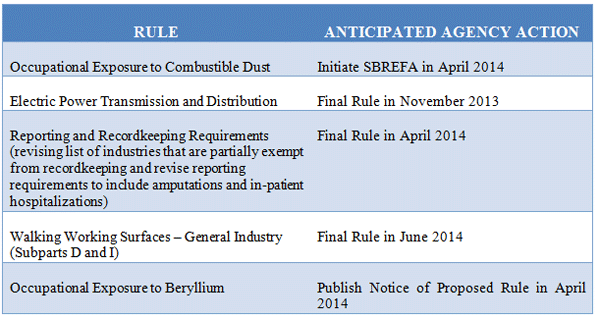
Additional regulatory actions under consideration by OSHA include:

 OSHA-Blog-Chart-12032013

The full federal Unified Agenda and Regulatory Plan can be found online at: http://www.reginfo.gov/public/do/eAgendaMain.

The New York Court of Appeals’ 4-3 decision allowing subjects of drug tests to sue laboratories for “negligent testing” may hold a lesson for employers who desire to test their employees, particularly when conducting on-site testing using specimens other than urine. It illustrates risks that attend employment-related drug testing, although the issue in the case was whether a laboratory that contracted with a county probation department to analyze drug tests performed on probationers may be liable to a test subject for a negligent drug test. Landon v. Kroll Laboratory Specialists Inc., 2013 NY Slip Op 6597 (Oct. 10, 2013).  Read the full article here.

The Occupational Safety and Health Administration’s (“OSHA”) Notice of Proposed Rulemaking to “Improve Tracking of Workplace Injuries and Illnesses” was published in the Federal Register on November 8, 2013.  The proposed rule amends the recordkeeping regulations to add three new requirements for the electronic submission of injury and illness information to OSHA.  In addition, OSHA will publicly post the electronically-submitted injury and illness information on its website and may create a searchable online database.  Employers and the public will have until February 6, 2014, to submit written comments on the proposed rule.   

The proposed rule does not expand coverage of the recordkeeping requirements or change the information that an employer is currently required to collect and maintain under 29 C.F.R. Part 1904.  Only those employers, who are already required to keep injury and illness records, will be subject to the new electronic-submission requirements discussed below.  Thus, employers with 10 or fewer employees or establishments in certain low-hazard industries, such as finance, insurance, retail, or real estate, are not subject to the new electronic requirements unless OSHA informs them in writing to keep such records and electronically submit them.    Continue Reading OSHA’s Proposed Electronic Recordkeeping Rule

By adopting the “Florida Ban on Texting While Driving Law,” Florida has joined 41 other states where texting while driving is illegal. The new law prohibits, as a secondary offense, manual texting, e-mailing and instant messaging on a wireless device while driving. Drivers cannot be pulled over for texting alone; rather, the driver must have engaged in a separate traffic offense. The new law adds Section 316.305 to the Florida Statutes and amends other sections.  Read the full article here.

Employers whose employees may be exposed to hazardous chemicals in the workplace must train their employees on the Occupational Safety and Health Administration’s new labeling elements and new Safety Data Sheet format by December 1, 2013.  Additional details can be found here.

Property owners wishing to prohibit concealed firearms from being carried on their property must post officially approved signage conspicuously at the entrance of their building, premises or real property, according to a regulation published by the Illinois State Police. Owners of parcels where concealed carry is prohibited by the Illinois Firearms Concealed Carry Act also must post the required sign in the same manner.  Read the full article here.

Their regular duties put on hold by the government shutdown, the Mine Safety and Health Administration (MSHA) and the Occupational Safety and Health Administration (OSHA) are operating under contingency plans to guard against imminent safety and health threats, while legal challenges to these agencies’ enforcement proceedings have largely been suspended.
MSHA’s plan to weather the shutdown is to keep 41 percent of its workforce of 2,355 on the job. This is in sharp contrast to OSHA, which said it requires just 230, or 10 percent, of its 2,235 employees to address essential functions.

The mine safety agency’s employees will be used to continue impact inspections, which target mines MSHA believes have a history of putting miners at risk. Hazard-specific inspections aimed at conditions and practices that have led to recent mine fatalities and serious injuries will continue. Also undisturbed will be investigations into accident and miners’ safety complaints, as well as selective sample analyses. To support these activities, a minimal level of supervisory staff will be maintained at all of MSHA’s district and field offices.

MSHA also said it would continue to perform certain plan reviews and approvals, provide information technology support, maintain a minimal emergency response presence and provide security at the Mine Academy and at its facility in Triadelphia, WV.

OSHA said it will continue to enforce both imminent danger situations and activities involved in responding to workplace fatalities and catastrophes. In addition, OSHA will maintain staff to respond to emergencies and to safety and health complaints or other information deemed to present a high risk of death or serious harm. A key function of its compliance staff during the shutdown will be to assist in tracking and processing open cases/citations to ensure statute of limitations dates do not lapse.

OSHA’s 10 regional offices will remain open with minimal staff. Senior compliance officers specializing in safety and in health (one each) will staff each of its 92 field offices, and its Salt Lake City Technical Center will retain two senior chemists and two industrial hygienists from its health response unit.

Meanwhile, with staffing at the Office of the Solicitor of Labor cut by 90 percent and the Office of Administrative Law Judges cut to zero, Department of Labor attorneys are handling only core legal services required of DOL agencies and cases involving human life or property protection. Four DOL attorneys remain assigned to MSHA. Attorneys will be added in cases where federal court litigation or statutes of limitations cannot be adjusted. However, the strategy for most cases will be to seek extensions, a move that will further clog the system and aggravate the case backlog.

Silica (quartz) is one of the most common minerals on earth and contained in or critical to the production or manufacturing of an endless array of products and industries, like electronics, concrete, glass, brick, foundries, oil and gas, transportation and construction.  The Occupational Safety and Health Administration (OSHA) has proposed a rule that would cut in half the permissible exposure limit (PEL) for respirable silica dust, and includes two standards:  one for general industry and maritime employers, and the other for construction industry employers.  Henry Chajet and I have developed a 60-minute webinar, where we explain the proposed silica regulations (which were published in the Federal Register on September 12, 2013), the potential impact those regulations may have on the workplace, and how to effectively participate in the rulemaking process.  You can access the webinar by clicking here.

In the wake of the West, Texas fertilizer plant explosion, three federal agencies have issued an advisory on how to store, handle and manage ammonium nitrate (AN) safely. The 19-page advisory from the EPA, OSHA and Bureau of Alcohol, Tobacco, Firearms and Explosives (ATF) focuses on high density, solid AN pellets and beads (prills) used in fertilizers, and details lessons learned from previous AN disasters. The EPA’s website contains the full text of the advisory as well as information on EPA Risk Management Plans. 

The agencies said their advisory would be updated after more information about the Texas explosion—which remains under investigation—is obtained.  15 people, including eight firefighters, died in the West Fertilizer Co. disaster in April.

According to the advisory, one of the key lessons learned from previous disasters is that the conditions of storage and materials co-located with AN are crucial to its safety and stability. Another lesson learned, according to the advisory, is that adding heat to break up clumps of AN can trigger a general detonation. The advisory also provides recommendations for hazard reduction that cover: storage/process conditions to avoid; building design; storage scenarios such as in bags, drums and in bulk; and fire protection. Other sections of the document address community emergency planning, emergency response, information resources, references, and applicable statutes and regulations.

In August, President Obama issued a directive aimed at improving chemical safety coordination among federal agencies and their state and local partners; enhancing information sharing; modernizing policies, regulations and standards; and working with stakeholders to identify best practices. The directive established a Chemical Facility Safety and Security Working Group, which facilitated the development of the advisory.