Authored by:  Linda Otaigbe

OSHA has recently issued several memoranda updating guidance on its Process Safety Management (“PSM”) standard. On June 5, 2015, OSHA issued a memorandum to Regional Administrators explaining how inspectors should enforce recognized and generally accepted good engineering practices (“RAGAGEP”) requirements. Among other things, OSHA explained that when an employer’s internal standards are more stringent than the relevant published RAGAGEP and the employer fails to follow its own more stringent internal requirements, OSHA may cite the employer under the relevant section of the PSM standard. A copy of the June 5, 2015 memorandum can be found online.

Also on June 5th, OSHA issued a memorandum to Regional Administrators revising its enforcement policy on the concentration that a chemical present in a process must have in order to determine whether the chemical is at or above the threshold quantity listed in Appendix A of the PSM standard. Recognizing the ambiguity that exists for the 126 out of 137 chemicals that do not have a minimum concentration listed along with their chemical names, OSHA has decided that a 1% concentration test is appropriate for employers to determine if the chemical in the process is at or above threshold limits and therefore covered by PSM. Thus, the new enforcement policy is as follows:

In determining whether a process involves a chemical (whether pure or in a mixture) at or above the specified threshold quantities listed in Appendix A, the employer shall calculate:

(a) the total weight of any chemical in the process at a concentration that meets or exceeds the concentration listed for that chemical in Appendix A, and

(b) with respect to chemicals for which no concentration is specified in Appendix A, the total weight of the chemical in the process at a concentration of one percent or greater.  However, the employer need not include the weight of such chemicals in any portion of the process in which the partial pressure of the chemical in the vapor space under handling or storage conditions is less than 10 millimeters of mercury (mm Hg).  The employer shall document this partial pressure determination.

In determining the weight of a chemical present in a mixture, only the weight of the chemical itself, exclusive of any solvent, solution, or carrier is counted.

A copy of this June 5, 2015 memorandum, which provides examples to illustrate the new policy, is available here.

OSHA issued its third memorandum related to PSM on July 22, 2015. This memorandum revises OSHA’s interpretation of the retail facilities exemption of the standard by expanding the number of retail facilities that are covered. Prior to this change, “an establishment was exempt from PSM coverage if it derived more than 50 percent of its income from direct sales of highly hazardous chemicals to the end user,” otherwise known as the 50 percent test. Now, the retail facilities exception applies only to “facilities, or the portions of facilities, engaged in retail trade as defined by the current and any future updates to sectors 44 and 45 of the NAICS Manual.” The facilities that are exempt under sectors 44 and 45 of the NAICS Manual include food and beverage stores, electronics and appliance stores, and general merchandise stores. A copy of the July 22, 2015 memorandum can be found here.

On May 4, 2015, OSHA published the Confined Spaces in Construction standard, 29 C.F.R 1926, Subpart AA.  The new standard is effective August 3, 2015.  Several interested stakeholders petitioned the agency for a delay in the August enforcement date citing the  need for additional time to train employees and obtain the necessary equipment to comply with the new requirements.

On July 8, 2015, OSHA issued a memorandum to Regional Administrators indicating that it “will not issue citations to an employer making good faith efforts to comply with the new standard”  between August 3, 2015 to October 2, 2015.   In order to establish good faith efforts, employers must either have provided training in compliance with the new standard, 1926.1207, or training under the previous requirement, 1926.21(b)(6)(i).

According to the memorandum, OSHA will consider whether an employer is engaged in good faith efforts by considering:

  • If employers have not trained employees under the new requirements, whether such training is scheduled to be conducted.
  • If employers do not have the necessary equipment, such as personal protective equipment, to comply with the new standard, whether such equipment has been ordered and is using alternative measures to protect employees.
  • If employers have made any additional efforts to train employees about confined spaces and protect them for the hazards of confined spaces.

Full enforcement of the new Confined Spaces in Construction standard will begin on October 3, 2015.  A copy of the memorandum can be found online.

In an interpretation letter to the National Athletic Trainers’ Association dated July 6, 2015, OSHA reversed its earlier interpretation that the use of kinesiology tape is considered medical treatment for recordkeeping purposes.

Late 2014, OSHA issued an interpretation letter to Ms. Linda Ballas, which stated that the use of kinesiology tape is considered medical treatment for OSHA recordkeeping purposes and is, therefore, recordable when used to treat a work-related injury.

In its most recent letter, OSHA indicated that it “reevaluated its classification of the application of kinesiology tape as constituting medical treatment.” According to the letter, OSHA reviewed information associated with kinesiology tape, such as patent applications, relevant instructional materials, directions on proper use, and assessments on the tapes effects and the nature of its medicinal, neurological and physical properties.

After this reevaluation, OSHA has now concluded that “[t]he use of kinesiology tape and other types of elastic taping is included within the definition of first aid treatment, and thus the use of such tape alone would not be considered medical treatment.”

The July 6, 2015 letter of interpretation may be found online.


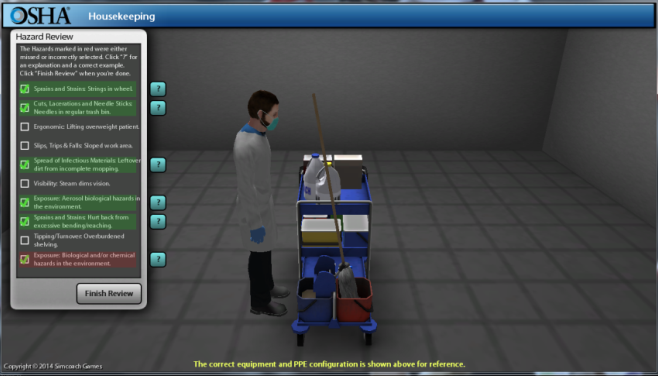
OSHA’s new Hazard Identification Training Tool is designed as “an interactive, online, game-based training tool for small business owners, workers and others interested in learning the core concepts of hazard identification.” Users enter a rudimentary virtual world where they are able to choose to visit one of four scenarios: OSHA Visual Inspection Training, Manufacturing, Construction, and Emergency Room.

OSHA recommends users start with the OSHA Visual Inspection Training where there is a choice of six different pieces of equipment.

person near cart video game

For example, choosing the “Housekeeping” option brings you to a screen with a cleaning cart and an employee. You are given a Hazard Checklist which you check off by using three tools: Inspect Equipment, Observe Operations, and Involve Worker. Once you have completed your inspection, OSHA gives you your results and the reasons behind the answers. Both inspecting the equipment and observing it in operation are more interesting than staring at a manual but, nonetheless, they are basic and fall short of providing all the answers. Involving the worker results in a series of word bubbles giving hints which directly correlate to the potential hazards. It is possible to score a near perfect score 100% of the time by simply involving the worker. Perhaps OSHA is consciously or subconsiously trying to emphasize the importance of involving workers in the health and safety of the workplace!

Choosing to enter one of the other scenarios lets you assume the role of the boss (owner or supervisor) or the worker. In the Manufacturing scenario, you, as the owner of the company, have “20 weeks to maximise your profit while keeping your workforce safe.” Each week you are allowed a maximum of 40 actions to identify and fix hazards – actions not used by the end of the week result in a profit. The Agency’s website summarizes it best: “The user determines how much time to spend on ensuring a safe and healthful work environment and how much to dedicate to making money.” However, in playing the game, it seems that the secret to making a profit is to consciously choose not to use all your actions, thereby spending less time identifying hazards and fixing only the most egregious hazards. In contrast, by using all 40 actions to identify and fix hazards, you will be operating at a loss. This would seem to run counter to the OSH Act which requires employers to provide their employees with working conditions that are free of known dangers. Perhaps with more practice using the hazard identification training tool it might be possible to be responsible while also maximising profits.

video game screen shot 1video game screen shot 2

The written Manual & Resources tab on the OSHA website (i.e., not an actual part of the game) offers the most concrete advice and acknowledges the importance of hazard identification to any business success. OSHA argues that management leadership needs to be aware and involved in this side of the business and that this kind of knowledge cannot be assumed but must be taught. The overview of the training tool is dotted with words and terms such as fundamentals, basics, generic hazard identification, and generalized elements. Taking the approach that the hazard identification training tool offers leaders and small business owners an opportunity in a somewhat fun virtual environment to understand and recognize the importance of identifying hazards, evaluate and prioritize them, while still trying to maintain profitability, demonstrates the value in this training tool. Additionally, by investing the time and money to have the hazards in the scenarios “randomized” OSHA has attempted to ensure that the game can be replayed “mutliple times with different hazard combinations appearing,” The Game Manual itself breaks down in a very readable format the equipment, work areas, people, and the relevant OSHA publications for each of the work scenarios covered – i.e., manufacturing, construction, and healthcare. In this way it is a useful reference tool.

Overall, OSHA scores highly for innovation in introducing this video game format as a way of teaching and learning. However, it is no competition for gaming enthusiasts used to the latest X Box or Playstation. In an ever evolving digital age, the hazard identification training tool has a long way to go to hold the attention of people who may not be “comfortable with the basics of hazard identification”, but who are very comfortable navigating their way through far more complex video games. We invite you to judge for yourself – the Hazard Identification Training Tool can be found on OSHA’s homepage, www.osha.gov.


OSHA issues new guidance to Regional Administrators and State Plan Designees on the enforcement of the Process Safety Management (PSM) standard’s recognized and generally accepted good engineering practices (RAGAGEP) requirements. The new guidance clarifies OSHA’s positions with respect to enforcing the PSM standards that reference or imply the use of RAGAGEP. The memorandum provides the most detailed information on how OSHA will handle PSM inspections with respect to the RAGAGEP requirements and it includes 16 detailed enforcement considerations that inspectors will evaluate when reviewing an employer’s compliance. The memorandum also provides specific guidance on when citations may be issued.

Employers covered under 29 C.F.R. § 1910.119 should carefully review their compliance with the following standards in light of this new guidance and OSHA’s renewed focus on the proper application of RAGAGEP to covered processes and equipment:

  • 119(d)(3)(ii) – The employer shall document that equipment complies with RAGAGEP.
  • 119(d)(3)(III) – For existing equipment designed and constructed in accordance with codes, standards, or practices that are no longer in general use, the employer shall determine and document that the equipment is designed, maintained, inspected, tested, and operating in a safe manner.
  • 119(j)(4)(ii) – Inspection and testing procedures shall follow RAGAGEP.
  • 119(j)(4)(iii) – The frequency of inspections and tests of process equipment shall be consistent with applicable manufacturers’ recommendations and good engineering practices, and more frequently if determined to be necessary by prior operating experience.

Issuance of this memorandum signals that inspectors will be looking more closely at these requirements during PSM-related inspections and that they will specifically be looking for information on whether employers have identified and documented the appropriate RAGAGEP that applies to each piece of equipment and are following the inspection and testing requirements including frequency of those inspections and tests.

Continue Reading Eight Tips for Addressing OSHA’s New Enforcement Guidance on RAGAGEP under the Process Safety Management Standard

Employers may soon find OSHA Compliance Safety and Health Officers (CSHOs) asking for additional information during the course of an OSHA inspection. On July 31, 2014, the President signed Executive Order 13673 (Order): Fair Pay and Safe Workplaces. The purpose of the Order is to ensure that employers who contract with the federal government (contracts worth over $500,000) are compliant with various labor laws, and that employers who are not complaint are not awarded federal contracts. According to a recent memorandum from Tom Galassi, Director for OSHA’s Directorate of Enforcement Programs, to OSHA Regional Administrators, this change marks “the first time, that the DOL and other federal agencies will have access to the labor law compliance record of employers bidding on government contracts.” (Memorandum to Regional Administrators, State Plan Designees, dated April 23, 2015.)

This memorandum instructs CSHOs to request additional data from employers during OSHA inspections. According to OSHA, “[t]he new information is necessary to provide a unified means of identifying companies on a government-wide database.” During the course of inspections, CSHOs will ask employers for the following information:

  1. Employer DUNS Number: Unique nine digit identifier issued by Dun & Bradstreet verifying the existence of a business entity globally;
  2. Employer DUNS + 4: Additional numbers included by the firm identifying affiliates and subsidiaries;
  3. Employer CAGE code: Commercial and Government Entity Code is a unique identifier assigned to suppliers of various government agencies;
  4. Employer currently a federal contractor: Yes or No;
  5. Parent Company DUNS Number;
  6. Parent Company DUNS plus 4;
  7. Parent Company CAGE code;
  8. Parent Company TIN/EIN: Taxpayer Identification Number and Employer Identification Number are defined as a nine digit number that the IRS assigns to organizations;
  9. Parent Company legal name: The legal name of a business is the name under which the business conducts its operations;
  10. Parent Company trade name / doing business as: A trade name, trading name, or business name is a name that a business uses for trading commercial products or services;
  11. Parent Company Contact Information:
    1. Street address
    2. City
    3. State
    4. Zip code
    5. Company phone number
  12. Imminent Danger notice(s) including issuance date.

According to the memorandum, the CSHOs may collect this information at any time during the inspection and if it is not available, they should note that it was not available, was unknown, or that it did not exist. The information will be entered into the OSHA Information System (OIS) and transferred nightly to a new central DOL Master Data Repository.

Employers should note that if for whatever reason they cannot provide the information, the inspection should proceed as normal and that their inability to provide the information will not have an adverse impact on the findings of the inspection.

OSHA issued a memorandum to Regional Administrators on April 22, 2015 to provide further guidance on evaluating the combustion hazards associated with dust accumulation. Currently, it is possible to infer from OSHA’s Directive, CPL 03-00-008, Combustible Dust National Emphasis Program (Reissued), that any dust accumulation of 1/32nd inch or more presents a deflagration or combustible hazard. However, combustible dust determinations are not that simple. Other factors need to be considered, including the area of dust accumulation (see section 6.1.3.2 of NFPA 654 (2013 edition) and the bulk density of combustible dusts.

The National Fire Protection Association’s consensus standard, NFPA 654, allows dust accumulation to exceed 1/32nd inch for materials with a bulk density less than 75 lb/ft3. According to OSHA’s guidance “[b]ulk densities of combustible dusts depend on many factors including the type of material (e.g. wood, paper, plastic, metal, etc.), the dust particle size, and the dust particle shape.” The memorandum includes the mathematical formula NFPA uses to make this determination. The formula is based on LD (layer depth) and BD (bulk density).  Both layer depth and bulk density are explained more fully but the guidance does instruct Compliance Safety and Health Officers (CSHOs) to consider the bulk density of a dust before determining whether a violation of 1910.22(a)(1), 1910.22(a)(2) or 1910.176(c) has occurred. Tissue dust is used as an example of a very low density dust which may not pose “a deflagration hazard even at an accumulation level of 1/4 inch, covering over five percent of the floor area of 1000 ft2, whichever is less.” The memorandum provides detailed instructions on how to test low density dust accumulations to determine their deflagration risk or combustibility.

According to Bloomberg BNA, OSHA does not anticipate that this guidance will materially alter the outcome of inspections. OSHA believes that most inspections involve dust accumulations so far in excess of the upper allowable limits that only in situations involving light dusts will bulk density be a deciding factor. However, this memorandum makes clear that the accumulation of 1/32nd inch of dust alone does not justify a citation.

A copy of OSHA’s memorandum can be found here.

On June 1, 2015, OSHA announced its new Best Practices: A Guide to Restroom Access for Transgender Workers. The core principle underlying OSHA’s best practices is that: “All employees, including transgender employees, should have access to restrooms that correspond to their gender identity.”

OSHA’s Sanitation standard (29 C.F.R. § 1910.141(c)) mandates that employers who fall under OSHA’s jurisdiction provide employees with sanitary and available toilets facilities for each sex. The total number of toilet facilities that must be provided is based upon the number of workers at each location. The requirement to provide readily available toilet facilities protects workers from the health risks (such as urinary tract and bladder infections) which may arise if employees are unable to use the restroom. Thus, according to OSHA, restricting employees to use only restrooms that are not consistent with their gender identity, or segregating them from other workers by requiring them to use gender-neutral or other specific restrooms can result in serious physical injury or illness when employees avoid using such restrooms altogether due to fear for physical safety or shame over being singled out.

OSHA’s model practices for restroom access for transgender employees advises that employers allow employees to use whichever restroom corresponds to an employee’s internal gender identity and that employees be given the freedom to determine the most appropriate and safest restroom option. OSHA notes that transgender employees should not be discriminated against by being singled out to use a gender neutral bathroom, nor should they be denied access to the bathroom which corresponds to their internal gender identity. For example, if someone lives his life as a man who was designated female at birth, he should be able to use the male restrooms at work; similarly, someone living as a woman whose birth certificate labels her male, should be allowed to use the female restrooms at work. OSHA also advises under the model practices that employers not require employees to provide any medical or legal documentation regarding their gender in order to access the restroom that corresponds to their gender identity.

OSHA has suggested two options to employers rather than the traditional Male/Female bathrooms. Employers can designate single-occupancy bathrooms as gender-neutral for use by all their employees or install multi-occupant, gender-neutral restroom facilities with lockable single occupant stalls.

OSHA encourages employers to check state and local laws and regulations for any localized variances and notes that Colorado, Delaware, District of Columbia, Iowa, Vermont and Washington have state laws regarding restroom access. In the best practices, OSHA also makes employers aware that in April 2015, the EEOC ruled that denying a transgender employee access to a restroom consistent with his/her internal gender identity constitutes sexual discrimination under Title VII.

To read the News Release and Best Practices Guide to Restroom Access for Transgender Workers in full, go to https://www.osha.gov/newsrelease/trade-20150601.html

The safety data sheet and label format requirements under OSHA’s revised Hazardous Communication Standard officially went into effect on June 1, 2015.  Employers are encouraged to review their safety data sheets and labels to ensure that the meet the new requirements and align with the UN Globally Harmonized System of Classification and Labelling of Chemicals.  Employers should contact their distributors and manufacturers if they have yet to receive updated safety data sheets and labels and document such communication and follow-up in the event that OSHA requests such information.

In a May 29, 2015 memorandum, OSHA indicates that the Hazard Communication directive will be issued in the near future.  While the June 1, 2015 has passed, OSHA has provided some additional guidance on what this requirement means for already packaged stock and for manufacturers, importers and distributors who are not ready for the change.  Specifically, OSHA notes that manufactures, importers of hazardous chemicals and businesses that repackage do not need to re-label packaged shipment containers with 2012-compliant labels if boxed, palletized, shrink-wrapped.  However, 2012-compliant labels and safety data sheets must be provided for each individual container shipped, unless the manufacturer or importer can demonstrate that it had not received classification information from its upstream suppliers and had exercised reasonable diligence and made good faith efforts to obtain such information.

The memorandum reminds distributors that they can continue to ship existing boxed, palletized, shrink-wrapped stock chemicals with 1994-compliant labels until December 1, 2015.  Distributors will not be required to re-label packaged for shipment containers with HCS 2012-compliant labels.  However, distributors will be required to provide a HCS 2012-compliant label and safety data sheet for each and every individual container shipped with any future shipments after December 1, 2015 or upon request, unless they can demonstrate reasonable diligence and good faith.

OSHA reminds individuals that reasonable diligence and good faith may be demonstrated by manufacturers and importers if they can provide documentation to show efforts to:

  • Obtain classification information and safety data sheets from upstream suppliers;
  • Find hazard information from alternative sources; and
  • Classify the data themselves.

More information on the Hazardous Communication requirements can be found at OSHA’s website:  https://www.osha.gov/dsg/hazcom/index.html


On May 21, 2015 the spring semiannual regulatory agenda for federal agencies was published. This Regulatory Agenda provides a complete list of all regulatory actions that are under active consideration for promulgation, proposal, or review and covers regulatory actions for over 60 federal departments, agencies, and commissions.

The regulatory agenda for the Department of Labor includes a total of twenty three regulatory entries for OSHA specific actions. Seven of these regulatory actions are in the prerule stage where the agency is gathering relevant information. Eight are in the proposed rule stage and another eight of these specific actions are in the final rule stage.

Combustible Dust and Communication Tower Safety remain in the prerule stage. Crane Operator Qualifications in Construction, Silica and Beryllium are in the proposed rule stage. Additionally, OSHA has added agency action for “Clarification of Employer’s Continuing Obligation to Make and Maintain Accurate Records of Each Recordable Injury and Illness.” According to OSHA this proposed rule is meant to “clarify that the duty to make and maintain an accurate record of an injury or illness continues for as long as the employer must keep and make available records for the year in which the injury or illness occurred. The duty does not expire if the employer fails to create the necessary records when first required to do so.”  This agency action is an attempt by OSHA to undo the holding in the U.S. Court of Appeals for the District of Columbia’s decision in the Volks case, which held that OSHA could not issue citations for failing to record an injury or illness beyond the six-month statute of limitations set out in the statute. AKM LLC d/b/a Volks Constructors v. Sec’y of Labor, 675 F.3d 752 (D.C. Cir. 2012).

In this regulatory agenda, OSHA moved its infectious disease rulemaking from active rulemaking to the long-term action list. Also on this list remains a proposed rule for an Injury and Illness Prevention Program rule (I2P2), which was shifted to a long term agency goal in May 2014.

Additional regulatory actions under consideration by OSHA include:


RULE


ANTICIPATED AGENCY ACTION

Walking Working Surfaces – General Industry (Subparts D and I)

Final Rule in August 2015

Improve Tracking of Workplace Injuries and Illnesses

Final Rule in September 2015

Occupational Exposure to Crystalline Silica

Analyze public comments June 2015

NOTE:   The regulatory agenda did not list a final rule date for this standard

Occupational Exposure to Combustible Dust

Notice of Proposed Rulemaking in May 2015

Crane Operator Qualification in Construction

Notice of Proposed Rulemaking in December 2015

Clarification of Employer’s Continuing Obligation to Make and Maintain Accurate Records of Each Recordable Injury and Illness

Notice of Proposed Rulemaking in May 2015

Process Safety Management and Prevention of Major Chemical Accidents

Initiate SBREFA in June 2015


The full federal Unified Agenda and Regulatory Plan can be found online at:

http://www.reginfo.gov/public/do/eAgendaMain